
Six Places Across Asia That Have Built Themselves Around The Practice Of Stillness
There is a particular kind of exhaustion no holiday cures. It does not sit in the body. It lives in the operating system in the part of the mind that never quite stops processing, scanning, anticipating. Even in sleep, it works.
The Indian operator knows this register. It is the cost of a decade spent building, and it does not respond to ordinary rest. What it asks for is something narrower and more difficult: stillness, practised seriously, in environments built for it. A small number of properties across Asia have made this their entire architecture. None of them market themselves as luxury wellness. All of them are. The distinction worth noting is that they are not retreats from life. They are calibrations for it.
Where Stillness Lives
For those who take this seriously, the environment matters. Silence is not just the absence of sound. It is the presence of the right conditions spaces that support stillness rather than simulate it. Across Asia, a new category of destinations has emerged not as retreats from life, but as extensions of it.
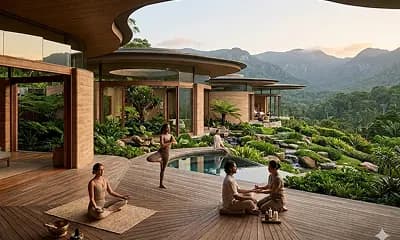
Silence as Strategy
This is not wellness as indulgence. It is not a spa weekend rebranded as self-care. It is the deliberate practice of stillness as a performance tool. Because the most dangerous thing a founder can do is never stop. And the most powerful thing they can do is silence everything and listen. The science supports what ancient traditions have always known. In a world where the brain is flooded with unprecedented levels of information, silence activates the default mode network — the part responsible for creativity, self-reflection, and long-term thinking.
Without it, decision-making becomes reactive. Strategy collapses into execution. The urgent overrides the important. A study from the University of Lübeck found that individuals given rest even without sleep were nearly twice as likely to uncover hidden solutions to complex problems. The rested mind sees what the exhausted mind cannot. For someone building a business, that difference compounds. Even thinkers like Yuval Noah Harari credit annual silence retreats as the single most important practice behind their clarity of thought. In the language of modern ambition: Silence is not withdrawal. It is advantage.
The Indian Founder's Return to Stillness
India is not new to the idea of stepping away. The concept of withdrawal of retreating from the world to return with greater clarity is embedded in its oldest philosophies. The Vipassana tradition, revived in modern times, continues to draw practitioners seeking precisely this reset. What is new is its adoption by the business community. Across Mumbai, Bengaluru, and Delhi, founders are speaking often privately about ten-day silent retreats that reshaped how they think. About uninterrupted time with their own mind, after years of external noise. One CEO described it simply: Running a company meant my mind was always occupied. Filling the rest with content left no space to think. Silence gave that space back. This is the shift. The realisation that the mind, like any high-performance system, requires calibration. And that calibration can't happen in noise.
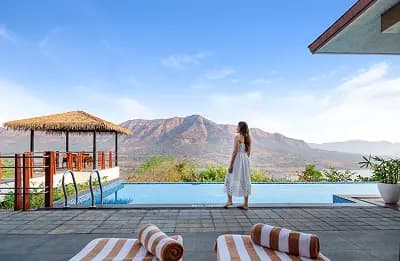
1. Atmantan Wellness Resort | Mulshi Lake, Maharashtra
The strongest argument for a programme that begins with diagnosis. Body composition, stress markers, lifestyle patterns, nutritional analysis all mapped before a single therapy is scheduled.
What follows integrates Ayurveda, naturopathy, physiotherapy, yoga therapy, and functional nutrition into a single sequenced regime. The lake stays still through most of the day. The Sahyadri hills hold the horizon. For the high-functioning urban mind, Atmantan is the rare institution that slows you down without losing precision.
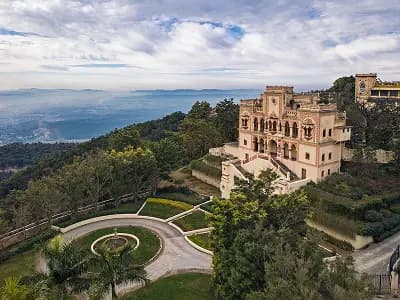
2. Ananda in the Himalayas Above Rishikesh, India
Ananda does not introduce you to wellness. It assumes you arrived for it. Set on a hundred-acre palace estate above the Ganges, the property operates with the seriousness of a school. Its Dhyana programme follows the Raja Yoga tradition not as guided relaxation but as a discipline, asking for sustained attention rather than passive receipt.
Ayurvedic therapies are matched to constitution, not preference. The food is structured to internal restoration. The buildings are restrained on purpose, allowing the Himalayan foothills to remain the focal point.
Mornings begin before the sun fully clears the ridge. Evenings close without stimulation. Time at Ananda is not slowed. It is differently calibrated. For the Indian guest, the more interesting fact is that the most rigorous wellness institution on the continent is the one closest to home.
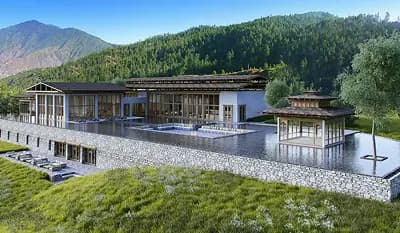
3. Six Senses Bhutan
This is not a single destination , but a circuit across five lodges - Thimphu, Punakha, Paro, Gangtey, and Bumthang , the experience is designed as a journey, not a destination. Sunrise meditations on Himalayan ridgelines, traditional dotsho hot-stone baths infused with khempa herbs, monastery visits that read less as excursions than pauses. By the final valley, the stillness has internalised. What stays with you is not a moment but the continuity of it.
4. Kayaam Wellness | Tangalle, southern Sri Lanka
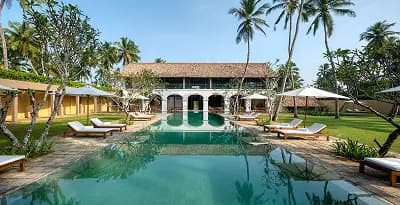
Nine rooms. The scale is the point. Designed in the spirit of Geoffrey Bawa, the architecture dissolves the line between interior and landscape. A resident doctor tracks each guest's progress daily. Meals adjust to dosha and therapeutic need. Treatments evolve in response rather than to a schedule. The Ayurvedic tradition is held seriously, but the more particular offering is attention itself continuous rather than episodic.
5. Kamalaya Wellness Sanctuary | Koh Samui, Thailand
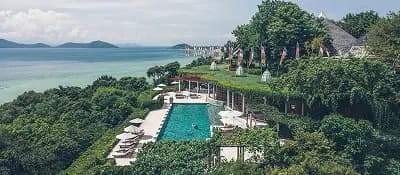
At the centre of Kamalaya is a cave. Buddhist monks used it for meditation long before the property was built around it. Everything else the pathways through dense coastal greenery, the open-sided pavilions, the sea views that flatten the horizon exists in relation to it. The cave was not designed. It was inherited. What follows from that orientation is a sanctuary whose approach to stress is psychological rather than cosmetic. The flagship programmes treat their subject's burnout, sleep, emotional regulation, life transitions as patterns rather than symptoms. Traditional healing sits alongside modern therapeutic frameworks. Structured introspection is built into the daily rhythm. The cave does not feature in the brochure as an attraction; it functions as a reminder. This kind of silence existed long before it became a service.
6. Joali Being | Raa Atoll, Maldives
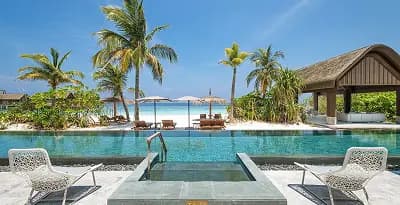
In a region that tends toward spectacle, JOALI Being subtracts. There is no resort layered over a wellness offering the wellness is the architecture. Four pillars: mind, skin, microbiome, energy. Each guest begins with integrative diagnostics and a movement assessment. What follows is not a menu but a designed sequence. The ocean is not a view here. It is a presence rhythmic, grounding, constant. Luxury, at JOALI, is the discipline of elimination
A Considered Preview
THREE EDITORIAL FEATURES FROM ISSUE 02, SHARED OPENLY. THE REST, BY DESIGN, REMAINS PRIVATE.


Read the full story
AFTER THE CITY
Wildlife safaris worth the silence

Read the full story
THE EASTERN RESET
Wellness retreats across Asia

Subscribe Today
Unlock enticing glimpses into every issue.